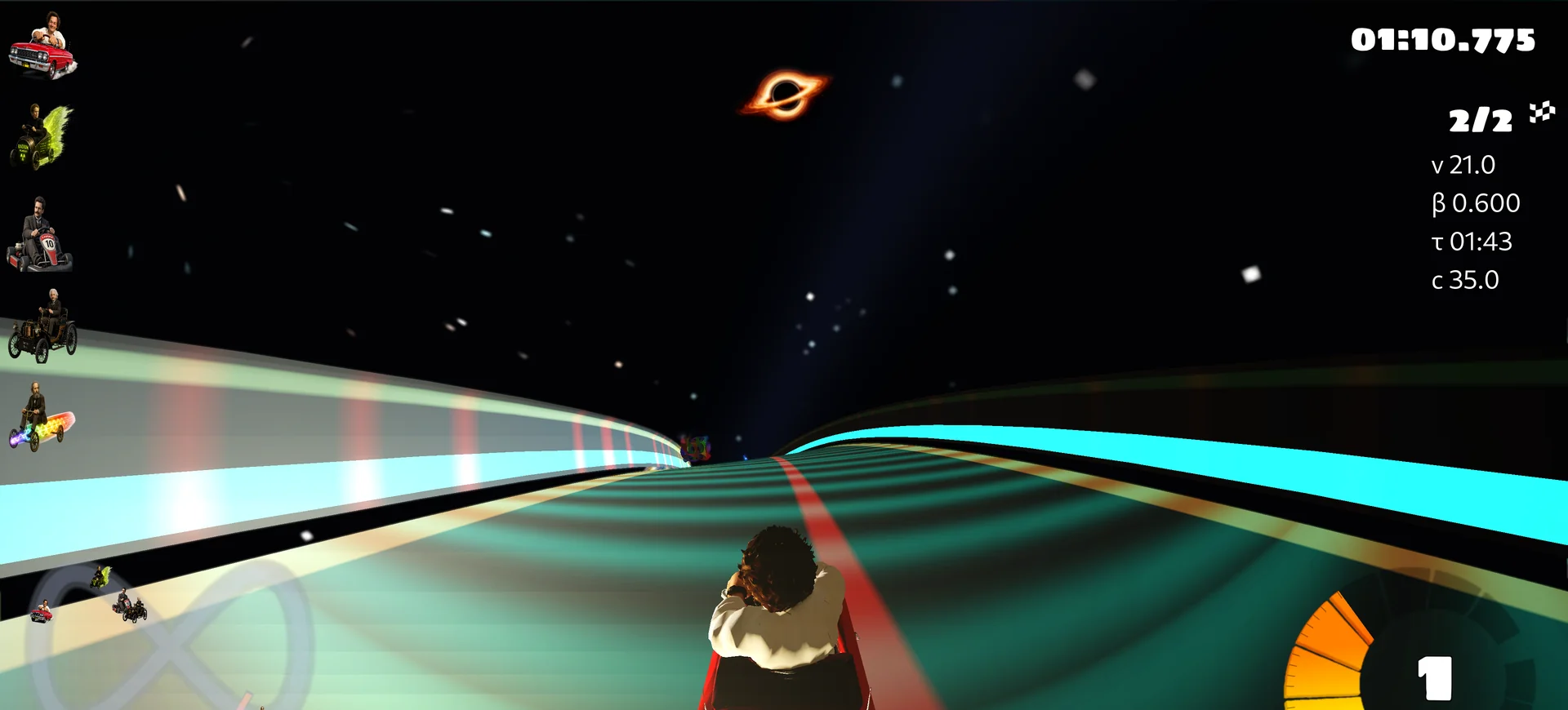
Relativistic aberration
The CPU and GPU implementations transform viewing directions using a Lorentz-derived aberration mapping. At high beta, forward and peripheral directions appear redistributed.
Source-linked guide
See how special-relativity calculations power the telemetry, visual effects, and arcade mechanics of every race.
Special relativity
The in-game speed of light c is adjustable from 15 to 1000 game units per second. For a kart moving at speed v, the relativity module calculates beta and the Lorentz factor:
Beta equals speed divided by the speed of light; gamma equals one divided by the square root of one minus beta squared.
Per-kart proper time accumulates at Δτ = Δt / γ. The race HUD can display velocity, beta, proper time, and the configured c. Ordinary race timing remains coordinate time; proper time is additional telemetry.
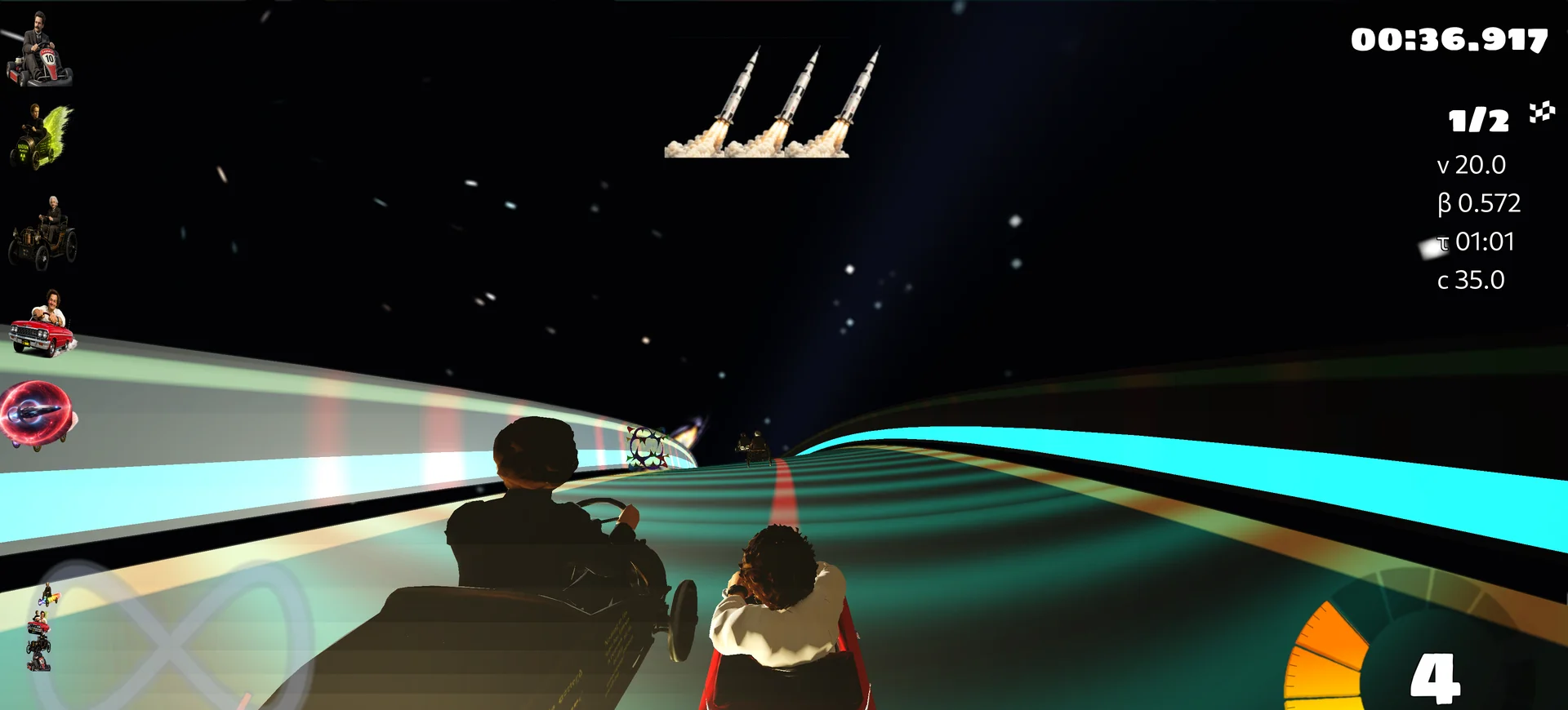
How objects look
The CPU and GPU implementations transform viewing directions using a Lorentz-derived aberration mapping. At high beta, forward and peripheral directions appear redistributed.
The renderer estimates where light would have left a moving object before reaching the observer, then combines that apparent position with the aberration mapping.
Renderer scope: the scene pipeline applies aberration and apparent-position transforms while leaving the underlying positions, normals, and tangents stable for responsive racing.
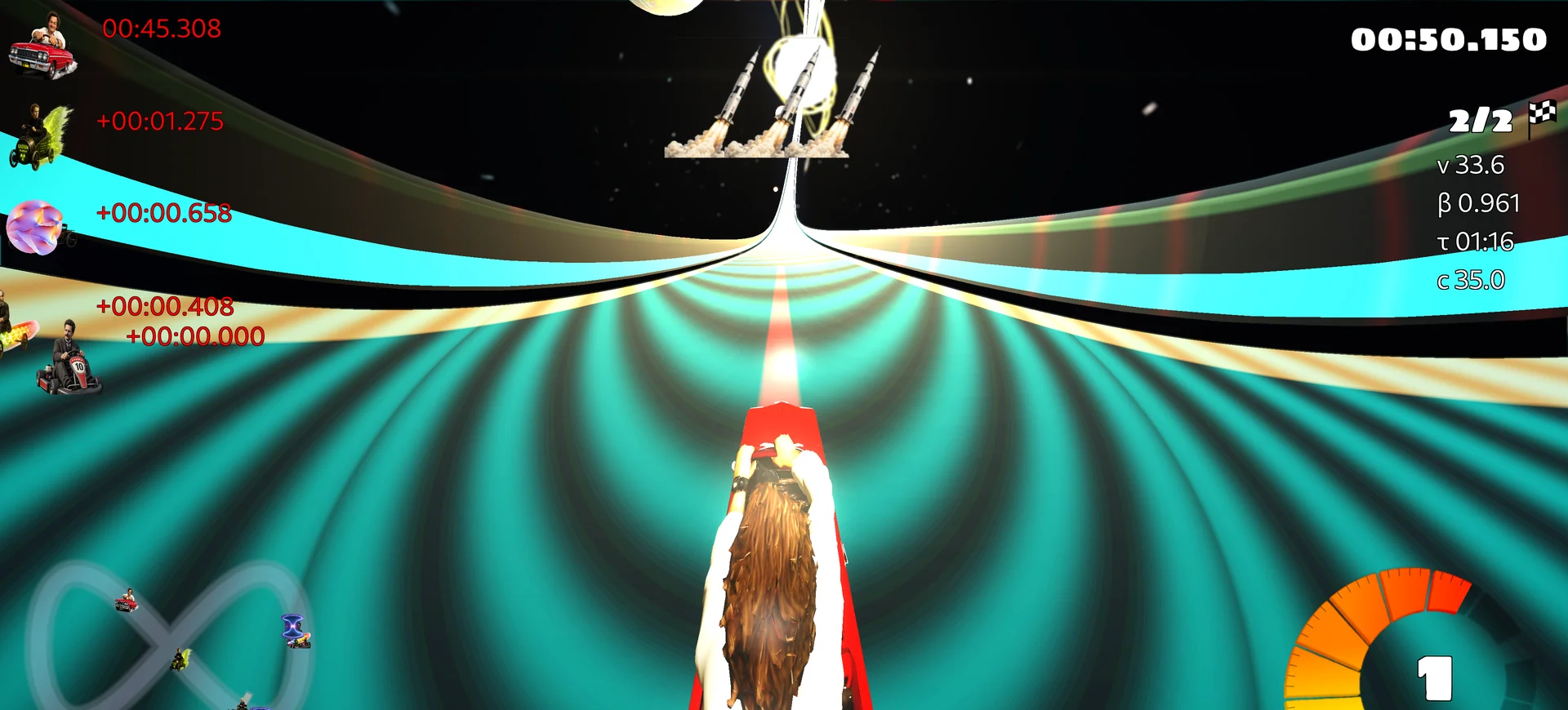
Colour and direction
The colour shader calculates a directional Doppler/searchlight factor based on gamma and the angle between velocity and view direction. It approximately remaps RGB energy through spectral response curves and applies relativistic beaming.
Current runtime code activates the effect for selected item and status states, including particular photon, squash, and bomb effects. These moments create a directional burst of colour tied to the action.
Mechanics
A wave expands to a 75-unit radius over three seconds. Eligible opponents inside it receive a delayed, distance-scaled reduction in effective c; shields can absorb the effect.
A heavy projectile steers toward a target, bringing analytic lensing and accretion-disc effects into the racing line.
Two linked endpoints form a bidirectional shortcut. Entering one moves the kart to the other while transforming orientation and velocity.
Curved-spacetime inspiration
Black-hole and wormhole effects make curved-spacetime ideas legible at racing speed. The displacement shader uses procedural analytic shapes and screen-space distortion to deliver fast, readable lensing.
Wormholes teleport physical game objects between linked endpoints, with distortion signalling the shortcut as players approach.
Read the lensing shader notes · Read the wormhole implementation